Tracking RPE: when to stop counting reps and start counting effort
Unlock smarter training with RPE: learn what it means, why it beats percentage programs, and how to log it in Ascend for optimal gains. Ditch rep counting, embrace effort tracking.
In this article
# Tracking RPE: when to stop counting reps and start counting effort
For too long, the fitness world has been obsessed with numbers: reps, sets, weight. And while these metrics are undeniably important, they only tell part of the story. What about the *effort*? What about the day-to-day fluctuations in your body's readiness? This is where Rate of Perceived Exertion (RPE) steps in, offering a more nuanced, intelligent approach to training that Ascend Fitness embraces fully.
At Ascend, your fitness journey is mapped to the ascent of a real mountain. Just like a real climb, some days you'll feel like you could conquer Everest, and other days, a small hill feels like a monumental task. Relying solely on static numbers ignores this fundamental truth of human performance. RPE helps you listen to your body, train smarter, and ensure every step you take pushes you further up your personal peak.
What is RPE, Really?
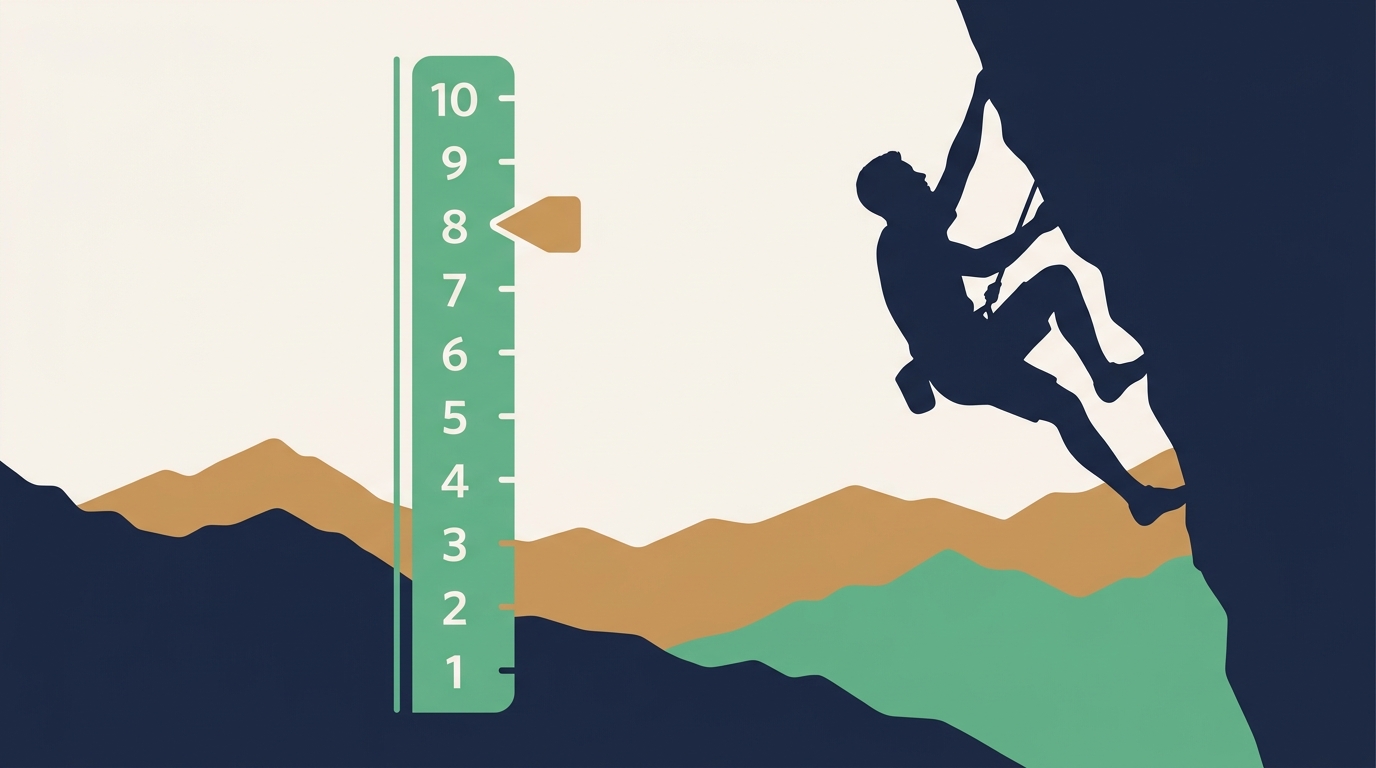
In its simplest form, RPE is a subjective scale used to quantify the intensity of a physical activity. While cardio often uses a general Borg scale, in resistance training, RPE is typically linked to "Reps in Reserve" (RIR). It's a 1-10 scale, where:
* RPE 1: No effort at all (like sitting on the couch). * RPE 10: Maximal effort, you could not complete another repetition with good form. This corresponds to 0 Reps in Reserve (RIR). * RPE 9: Extremely hard, you could have done one more rep. This is 1 RIR. * RPE 8: Very hard, you could have done two more reps. This is 2 RIR. * RPE 7: Hard, you could have done three more reps. This is 3 RIR. * RPE 6 and below: Moderate to easy effort, typically 4+ RIR, often used for warm-ups or very light recovery work.
Crucially, RPE in resistance training isn't just about how hard your muscles *feel*. It's about how many *quality repetitions* you genuinely believe you could have completed *after* the set was finished. This distinction is vital. A set might burn like crazy, but if you could still grind out two more reps, it wasn't an RPE 10. Research, such as that by Zourdos et al. (2016), has extensively explored the practical application and reliability of the RPE/RIR scale in resistance training, affirming its utility.
Why RPE Trumps Prescribed Percentages
For years, many training programs relied heavily on prescribing weights as a percentage of your one-repetition maximum (1RM). While this has its place, it comes with significant drawbacks:
* Static and Inflexible: 75% of your 1RM is 75% of your 1RM, regardless of how you slept, what you ate, your stress levels, or if you're recovering from a tough week. Your strength and readiness fluctuate daily, sometimes by as much as 10-20%. * Overtraining/Undertraining Risk: On a bad day, 75% might feel like a true RPE 9, leading to excessive fatigue. On a great day, it might feel like an RPE 6, leaving gains on the table. * Requires Frequent 1RM Testing: To keep percentages accurate, you'd need to test your 1RM regularly, which is fatiguing and impractical for most people.
RPE-based training, on the other hand, offers unparalleled advantages:
* Dynamic Adaptability: RPE auto-regulates your training. If you're feeling strong, an RPE 8 will naturally mean a heavier weight. If you're tired, an RPE 8 will mean a slightly lighter weight. The *stimulus* – the effort – remains consistent, ensuring you're always training optimally for your current state. * Optimised Stimulus: It ensures you're getting the right amount of challenge without overshooting or undershooting. This leads to more consistent progress over time, as demonstrated in studies comparing RPE-based training to fixed-load approaches (Helms et al. 2016). * Superior Fatigue Management: By listening to your body's daily RPE, you can prevent excessive central nervous system fatigue. This is crucial for long-term adherence and avoiding burnout, helping you maintain a steady climb up your mountain. * Intuitive Deloading: Deload weeks can be easily managed by prescribing lower RPEs (e.g., all sets at RPE 6-7), allowing for recovery without completely stopping training.
Logging RPE in Ascend: Your Ascent to Smarter Training
Ascend Fitness is designed to make RPE logging seamless and insightful. After each set of a resistance workout, you'll log the weight, reps, and then select the RPE from a simple interface. This might seem like an extra step, but it's a powerful one.
* Granular Data: We don't just ask for a workout RPE; we log it per set. This captures the true ebb and flow of your effort throughout a session, providing a richer dataset. * Personalised Insights: Over time, Ascend uses this data to show you trends. You might discover that certain exercises consistently feel harder than expected, or that your RPEs are higher on days you've had less sleep. This feedback loop is invaluable for learning to interpret your body's signals. * Objective Self-Assessment: Consistent RPE logging trains you to become more attuned to your own body and its capabilities. It turns a subjective feeling into a quantifiable metric that drives your progress up your virtual mountain.
This isn't just about punching in a number; it's about building a deeper connection with your training, making informed decisions, and ultimately, achieving more sustainable and profound results.
Common RPE Mistakes (and How to Avoid Them)
While RPE is a fantastic tool, it's not immune to misapplication. Here are some common pitfalls and how to navigate them:
* "Everything is an 8": This is arguably the most common mistake. Many users default to an RPE 8 for nearly every set. While many working sets will fall into the 7-9 range, not *every* set is an 8. If your warm-up sets feel like an 8, your scale is off. Be honest and critical. Learn the difference between feeling like you could do two more reps (RPE 8) and three more reps (RPE 7).
* Ego-RPE: This happens when you intentionally underestimate your RPE to make yourself feel stronger or to hit a prescribed number. Claiming 1 RIR when you truly hit absolute failure (0 RIR) doesn't help you. The RPE scale is *your* personal feedback loop. There's no one to impress but yourself, and inaccurate logging only hinders your progress.
* Ignoring RPE on Warm-ups: RPE isn't just for heavy working sets. Even your first set with an empty barbell has an RPE (likely 1-3). Logging these helps calibrate your internal scale and provides a more complete picture of your session's total effort. It also helps you mentally transition into your working sets.
* Overthinking the Exact RIR: While we link RPE to RIR, don't get bogged down in trying to discern if it was *exactly* 2.5 RIR versus 2 RIR. RPE is a subjective scale, and its strength lies in its flexibility. Aim for consistency and general accuracy rather than perfect precision. It's a guide to better training, not a rigid scientific measurement to be stressed over.
RPE vs. Percentage Training: A Quick Comparison
To summarise, here's how these two common training methodologies stack up:
| Feature | Percentage-Based Training | RPE-Based Training |
|---|---|---|
| Primary Driver | Fixed percentage of 1RM | Perceived effort / Reps in Reserve |
| Adaptability | Low (static, ignores daily fluctuations) | High (dynamic, adjusts to daily readiness) |
| Fatigue Management | Poor (can lead to over/under-training) | Excellent (auto-regulates intensity for optimal recovery) |
| Learning Curve | Low (just follow the numbers) | Moderate (requires practice to calibrate RPE accurately) |
| Progress Tracking | Weight lifted, 1RM increases | Weight lifted, RPE consistency, auto-regulation, cumulative effort |
| Best For | Beginners (to learn movements), specific peaking phases | Intermediate/Advanced lifters, long-term sustainable progress |
Ready to train smarter and conquer your fitness peaks? Join the waitlist
FAQ
Common questions
What is RPE in weight training?
RPE is a 1–10 Rate of Perceived Exertion scale that quantifies how hard a set felt. In lifting it's tied to reps in reserve: RPE 10 is maximal effort with no reps left, and lower numbers mean more reps still available.
How does RPE relate to reps in reserve (RIR)?
They're inversely linked: RPE 10 equals 0 reps in reserve, RPE 9 is about 1 rep left, and RPE 8 is roughly 2 reps left. RIR is just the practical way most lifters estimate their RPE.
Is RPE better than percentage-based training?
For many lifters, yes. RPE adjusts to how you feel on the day, so you push when readiness is high and back off when it's low, rather than forcing a fixed percentage of your max regardless of fatigue.

Sam Wilson
Founder of Ascend Fitness. Building a gamified fitness tracker from Christchurch, NZ. Lifts, runs, and writes about both.
Start the climb
Turn today's read into tomorrow's first log.
Ascend Fitness is in private beta. Join the waitlist, early climbers jump the TestFlight queue and get a heads-up the day it drops.