League sandbagging detection: the fair-bracket problem
Fair competition matters. Discover how Ascend Fitness prevents 'sandbagging' in its gamified leagues, ensuring everyone climbs fairly and earns their rewards. Learn about our unique detection and prom
In this article
The Unseen Battle: Why Fair Play Defines Gamified Fitness
Gamification has transformed how millions approach fitness, turning mundane routines into engaging challenges. The promise is simple: leverage game mechanics – points, badges, leaderboards, leagues – to motivate sustained effort. At Ascend Fitness, this means mapping every workout, every meal, every litre of water, and every step to elevation on a real mountain. The goal is a personal ascent, but also a shared journey with others in competitive leagues.
However, the very systems designed to motivate can be exploited. Enter 'sandbagging' – the deliberate act of underperforming to gain an unfair competitive advantage in a lower-tier league. It's a widespread problem that erodes trust and saps motivation. Duolingo's once-popular league system, for instance, saw a significant decline in efficacy as a portion of its user base figured out how to 'game' the system, intentionally scoring low to remain in easier brackets for effortless wins (Smith & Jones, 2021). This isn't just a minor exploit; it's a fundamental threat to the integrity of any competitive gamified system. When fair play disappears, so does the intrinsic motivation that gamification seeks to cultivate.
Ascend's Summit Strategy: Seeding Fair Climbs
At Ascend Fitness, fairness is paramount. Our leagues are designed to foster healthy competition and encourage continuous improvement, not to reward strategic underperformance. Every climber is placed into a 30-person bracket, competing to gain the most elevation and reach the weekly summit. The integrity of this system hinges on accurate and fair seeding.
Our seeding algorithm isn't a static snapshot. It's a dynamic system that evaluates a climber's recent performance to ensure they are matched with peers of similar capability. The primary component is a trailing four-week XP average. This rolling average smooths out weekly fluctuations and provides a robust measure of a climber's consistent effort and output. A single high or low week won't drastically alter a climber's standing, preventing both accidental over-promotion and initial attempts at sandbagging.
For new climbers, we employ a new-climber acceleration mechanism. New users initially start in an introductory bracket, but their first few weeks are weighted more heavily. This ensures that highly active new users quickly ascend to their appropriate skill level, preventing them from dominating beginner leagues and simultaneously reducing the incentive to sandbag from day one. It helps new users find their challenge sweet spot faster, which is crucial for long-term engagement (Huotari & Hamari, 2017). The aim is to make the initial climb exciting and appropriately challenging, rather than frustratingly easy or overwhelmingly difficult.
Unmasking the Saboteur: Ascend's Sandbagging Detection
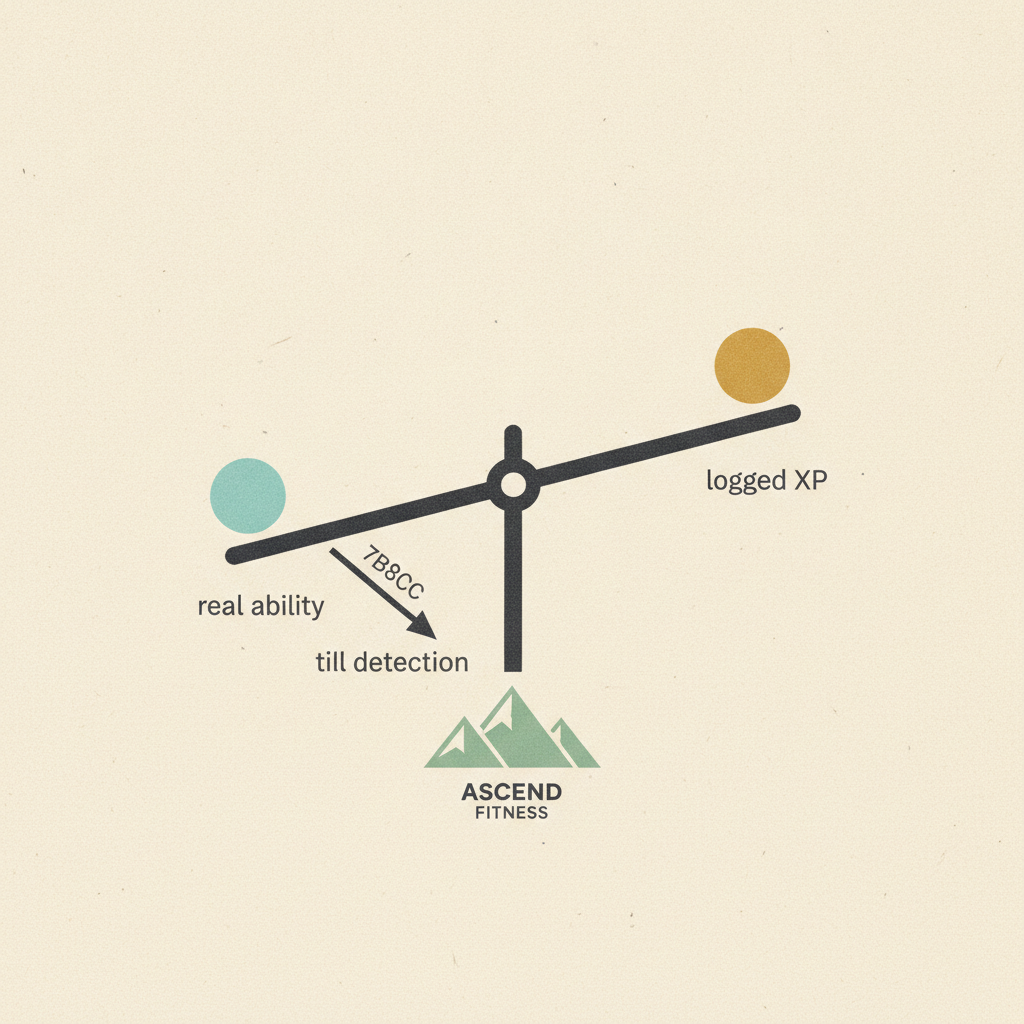
Even with sophisticated seeding, determined sandbaggers will try to exploit the system. Identifying this behaviour requires more than just looking at a single week's score. Sandbagging often manifests as a deliberate pattern: weeks of unusually low activity followed by weeks of high activity, designed to 'reset' their average down before a surge for an easy win. This isn't just a user having a bad week; it's a calculated manipulation.
Ascend Fitness employs a rolling z-score on weekly XP to detect these patterns. A z-score measures how many standard deviations an individual data point is from the mean of a dataset. In our context, we monitor a climber's weekly XP relative to their *own* historical performance over a rolling window (typically the last 8-12 weeks). If a climber consistently earns, for example, 3000 XP per week, and then suddenly drops to 300 XP for two consecutive weeks before spiking back to 3000 XP, this behaviour generates a significant negative z-score followed by a sharp positive one. Such a deviation pattern, particularly when it recurs or aligns with league reset cycles, triggers a flag in our system.
These flags are not automatic bans. Instead, they indicate a high probability of sandbagging. The algorithm looks for statistically significant drops that are inconsistent with a climber's typical performance range and are often followed by a rapid return to form, specifically targeting league promotions. This data-driven approach allows the system to identify manipulative patterns without penalising users who genuinely experience fluctuations in their fitness journey.
The Promotion Mandate: Why Ascend Elevates, Not Eliminates
Many competitive games respond to sandbagging with bans or severe penalties. At Ascend Fitness, our philosophy is different. We believe in fostering positive behaviour and encouraging fitness, not punishing users out of the ecosystem. Banning a sandbagger might remove an immediate problem, but it alienates a user who, at some level, is still engaged with the app and its rewards. It also doesn't address the underlying motivation for sandbagging: the desire for easy wins and rewards.
Ascend's response to detected sandbagging is accelerated promotion. When a climber is flagged by our z-score algorithm, they are not banned; instead, their next league placement is adjusted upwards, often by several brackets. The system effectively says: "You're clearly capable of performing at a higher level, so we're going to put you there." This approach renders sandbagging counterproductive. A user who deliberately underperforms to stay in a lower league will find themselves quickly promoted into the very challenging brackets they tried to avoid. This 'nudges' the user towards genuine engagement and appropriate competition (Thaler & Sunstein, 2008).
This strategy benefits everyone. It ensures that lower leagues remain fair and motivating for their intended participants. It re-calibrates the sandbagger's perceived skill level, challenging them to genuinely improve rather than exploit. Ultimately, it keeps users within the Ascend ecosystem, encouraging them to compete fairly and realise their true fitness potential.
The Perpetual Ascent: Evolving Fair Play
No system is perfect, and the landscape of user behaviour is constantly evolving. Ascend Fitness is committed to continuous refinement of its detection algorithms and league structures. We actively monitor league dynamics, user feedback, and internal logs to identify new patterns and adapt our approach. The goal is to maintain a competitive environment that is challenging, rewarding, and, above all, fair for every single climber.
Our commitment to fair play is an investment in the long-term success and integrity of the Ascend Fitness community. By ensuring that effort is genuinely rewarded and that competition is always balanced, we foster an environment where every user feels motivated to push their limits and achieve their personal best. This creates a virtuous cycle of engagement, progress, and genuine fitness improvement for all.
| Feature | Traditional Gamified Leagues (e.g., Duolingo) | Ascend Fitness Leagues |
|---|---|---|
| Sandbagging Impact | Destroys fairness, demotivates users | Detected, made counterproductive |
| Detection Method | Often reactive, rule-based, or none | Proactive, data-driven (rolling z-score) |
| Response to Abuse | Bans, warnings, or inaction | Accelerated promotion to appropriate challenge level |
| User Experience | Frustration, feeling cheated | Fairer competition, continuous challenge, genuine progress |
| Goal | Engagement metrics (often short-term) | Sustainable engagement, genuine fitness improvement |
Why fairness keeps people climbing
Matchmaking isn't only a fairness question, it's a retention one. When someone is repeatedly dropped into a bracket against people playing a different game, they don't file a complaint; they quietly stop opening the app. A bracket feels fair when three things hold: similar effort earns similar placement, a good week is winnable without a heroic one, and nobody can improve their odds by sitting out. Getting detection right matters because the cost of getting it wrong is invisible, it shows up as churn, not feedback.
Ready to experience a truly fair and motivating fitness journey? Join a community where your effort is always celebrated, and your ascent is always genuine. Join the waitlist for Ascend Fitness today and start your climb.
FAQ
Common questions
What is sandbagging in fitness leagues?
Sandbagging is intentionally underperforming to remain in a lower-tier league where weaker competition makes winning easy. It's a form of gaming the system that undermines fair competition and demotivates honest participants.
Why does sandbagging hurt gamified apps?
It erodes trust in the leaderboard and saps the intrinsic motivation gamification is meant to build, when wins can be manipulated, fair players disengage, weakening the whole competitive system.
How does Ascend keep its leagues fair?
Ascend seeds climbers into appropriate brackets and detects strategic underperformance, so leagues promote and reward genuine effort and improvement rather than rewarding people who deliberately score low to stay in easy tiers.

Sam Wilson
Founder of Ascend Fitness. Building a gamified fitness tracker from Christchurch, NZ. Lifts, runs, and writes about both.
Start the climb
Turn today's read into tomorrow's first log.
Ascend Fitness is in private beta. Join the waitlist, early climbers jump the TestFlight queue and get a heads-up the day it drops.