PR projection math: how Ascend forecasts your 1RM
Unlock your true strength. Ascend reveals the honest math behind its 1RM projections, blending science, velocity basics, and your data for precise, future-proof PR forecasts.
In this article
# PR Projection Math: How Ascend Forecasts Your 1RM
Every lifter chases that rush: the moment a new personal record (PR) is achieved. The weight feels heavy, the grind is real, but the bar moves. Then, the elation. But what if you could forecast that moment, not just guess? What if you had a data-driven compass guiding your path to new strength? That's precisely what Ascend's 1RM projection aims to provide.
Unlike many apps that offer a simple, often flawed, 1RM estimate, Ascend dives deeper. We don't just apply a single formula and call it a day. The honest truth is, accurate strength forecasting is complex. It requires blending established science with your unique training history. This post pulls back the curtain on Ascend's projection math, detailing how we combine tried-and-true principles with modern data analysis to give you the most reliable forecast of your true one-rep maximum.
The Illusion of a Single Formula: Why 1RM Prediction is Tricky
A one-rep maximum (1RM) is the maximum amount of weight you can lift for a single repetition in a given exercise. It's the gold standard for measuring strength progress, a benchmark that drives programming and motivation. However, directly testing your 1RM too frequently can be risky, fatiguing, and disruptive to your training cycle. This is where 1RM *prediction* comes in.
For decades, coaches and athletes have relied on various formulas to estimate 1RM from submaximal lifts. You've likely heard of them:
* Epley Formula (1998): `Weight × (1 + Reps / 30)` * Brzycki Formula (1993): `Weight / (1.0278 - 0.0278 × Reps)` * Lombardi Formula (1989): `Weight × Reps^0.10`
These formulas are valuable starting points, offering a quick estimate based on the weight and reps you can perform to failure (or near failure) in a single set. But they all share critical limitations. They were often developed for specific populations or rep ranges, and they assume a linear relationship between reps and percentage of 1RM, which simply isn't always true. Your fatigue levels, training experience, and even the specific exercise can significantly skew these single-formula predictions. Relying on just one of them is like trying to navigate a mountain with only a compass, ignoring the map and terrain ahead. It's a recipe for getting lost.
Beyond Reps: The Principles of Velocity-Based Training (VBT)
While Ascend doesn't directly measure bar speed with external sensors, the *principles* of Velocity-Based Training (VBT) are fundamentally woven into our projection logic. VBT operates on a simple, yet profound, premise: there's a strong inverse relationship between the velocity of a lift and the percentage of your 1RM (González-Badillo & Sánchez-Medina 2010). The heavier the weight relative to your max, the slower the bar moves.
Consider this: a set of 5 reps that flies up might feel like an RPE 7 (Rate of Perceived Exertion), meaning you had 3 reps left in the tank. The same 5 reps, grinding slowly, might be an RPE 9 or 10, indicating you were close to failure. The *speed* of the bar, even if only perceived, is directly correlated with how close you are to your true maximal effort. This is where RPE becomes a powerful proxy for velocity data. By accurately logging your RPE, you're giving Ascend crucial insights into how much effort you're expending and, by extension, how close you are to your 1RM for that given set and day.
Ascend's Secret Sauce: A Multi-Factorial Approach
Instead of blindly applying a single formula, Ascend's projection model is built on a robust, multi-faceted approach. We combine the best of established science with your real-world, personalized training data. Here's how it works:
* Consensus of Established Formulas: Ascend doesn't pick a favorite. Instead, it leverages a weighted consensus of the most reliable 1RM prediction formulas (like Epley, Brzycki, Lombardi, and others). This averaging effect smooths out the individual biases and limitations of any single formula, providing a more robust baseline estimate.
* Rate of Perceived Exertion (RPE): This is where your input becomes incredibly powerful. RPE is a self-assessment scale (typically 1-10) of how hard a set felt, with 10 being maximal effort (no reps left) and 7 meaning you had 3 reps left. When you consistently log your RPE for each set, you provide crucial context to the weights and reps. A 5-rep set at 100 kg with an RPE 7 suggests a higher 1RM than the same 5-rep set at 100 kg with an RPE 9. Research consistently supports the validity of RPE in resistance training for autoregulation and intensity control (Zourdos et al. 2016). Ascend integrates your RPE data to fine-tune the formula-based estimates, making them truly personalized.
* Training History & Trend Slope: This is arguably the most critical component. A single good or bad session shouldn't dictate your future. Ascend analyzes your training history for a given lift, specifically focusing on the most recent 8 weeks of data. We look for patterns, progress, and the *slope* of your performance trend. Are you consistently adding weight, reps, or lowering RPE for the same output? This trend data helps us understand your actual rate of adaptation and growth, providing a more stable and reliable projection than any single session ever could. It accounts for daily fluctuations and provides a true reflection of your long-term strength development.
This combination is superior because it balances theoretical models with your real-world, personalized data, and crucially, accounts for daily fluctuations and overall training progression. It's an intelligent system that learns *from you*.
Unpacking the Projection: 4, 8, and 12-Week Forecasts with Confidence Bands
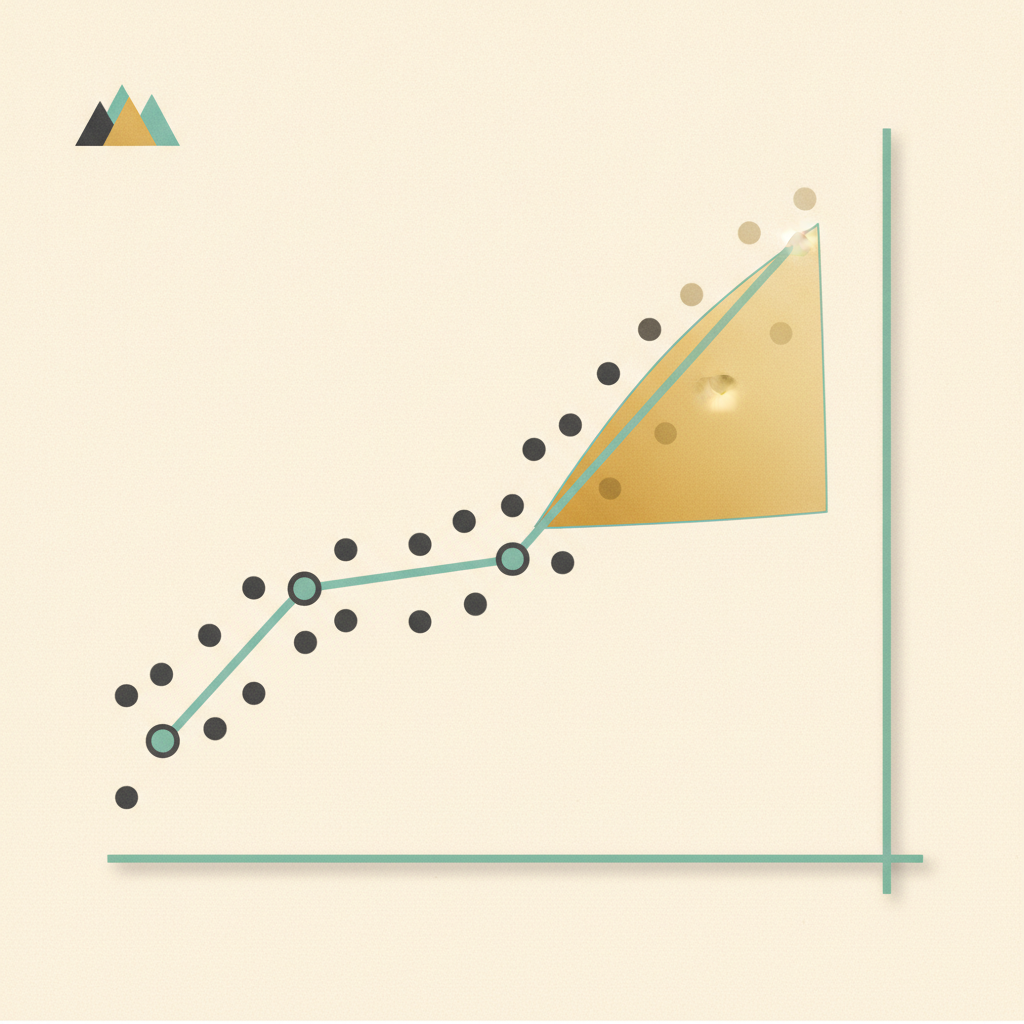
Ascend provides projections for different time horizons, each serving a distinct purpose in your training journey. These forecasts are accompanied by confidence bands, which are crucial for understanding the reliability of the prediction.
* 4-Week Projection: This is your short-term outlook. It's highly sensitive to your most recent training data, making it useful for immediate programming adjustments and gauging current strength levels within your mesocycle. If you've had a particularly strong week or are peaking, this projection will reflect that quickly.
* 8-Week Projection: This is Ascend's sweet spot and often the most reliable forecast. It balances recent performance with a stable trend from your last two months of training. This time frame typically aligns well with common training blocks and allows for enough data to smooth out minor daily variations, providing a robust estimate for your current programming cycle.
* 12-Week Projection: This is your long-term outlook, useful for macro-cycle planning and setting ambitious goals. However, naturally, it carries a broader range of uncertainty. Predicting your strength three months out involves more variables, and while it can guide your long-term vision, it should be viewed with a wider perspective.
Confidence Bands are the ranges around each projection, indicating the likely upper and lower bounds of your actual 1RM. Think of them as the margin of error. A narrower band signifies higher confidence in the prediction (e.g., consistent data, stable trend), while a wider band suggests more uncertainty (e.g., noisy data, longer projection horizon). They are a transparent acknowledgement that while data can predict, human performance inherently has variability.
When to Trust Your Projection (and When to Question It)
Ascend's projections are powerful tools, but like any tool, their effectiveness depends on how they're used and understood. Here’s when you should place your trust in them and when you should approach them with a critical eye:
Trust it when:
* Consistent RPE Logging: The more accurately and consistently you log RPE for your working sets, the better Ascend's model understands your effort and thus, your true strength. * Regularly Challenging Yourself: If you're consistently pushing yourself with sets that are RPE 7 or higher, the model has robust data points to work with. Training that is always easy (e.g., RPE 5 or lower) doesn't provide enough information for accurate max projections. * Consistent Training for the Lift: The model needs data for the specific lift. If you're consistently performing squats, your squat 1RM projection will be reliable. If you only deadlift once a month, the data will be sparser, and thus, less robust. * Clear Upward Trend: When your training logs show a consistent progression in weight, reps, or RPE for the same output, the projection will likely align with your real-world gains.
Question it when:
* Noisy Data: Inconsistent RPE logs, wildly fluctuating weights or reps for similar RPEs, or skipping RPE logging entirely will lead to less reliable projections and wider confidence bands. * Deload Weeks: During a deload, you intentionally lift lighter and perform fewer reps, often at lower RPEs. This will temporarily depress your projection, as the model interprets lighter loads as reduced strength. Understand this is a planned dip, not a true reflection of lost strength. * New Lifts: If you've just started a new exercise, there isn't enough historical data for Ascend to establish a reliable trend or RPE correlation. Give it a few weeks of consistent logging before fully trusting the projection. * Significant Life Stress or Illness: Performance can temporarily dip due to factors outside the gym (poor sleep, high stress, illness). While the projection might reflect this dip, understand it's a temporary physiological response, not necessarily a true loss of strength potential.
Remember, the projection is a sophisticated *estimate* designed to guide your training, not an absolute truth carved in stone. Use it to inform your programming, set realistic goals, and celebrate your progress, but always listen to your body first.
Climb Higher, Smarter
Ascend's 1RM projection is more than just a number; it's a testament to blending scientific rigor with personalized data. By understanding the multi-factorial approach – combining established formulas, your invaluable RPE input, and your long-term training trends – you gain a powerful tool for smarter, more effective training. Use these insights to navigate your fitness journey, set ambitious yet achievable goals, and ultimately, conquer new heights on your chosen mountain.
Why the rep range matters
Every 1RM estimate is an extrapolation, and it's most trustworthy near the weight you actually lifted. Formulas like Epley and Brzycki land within a few percent in the three-to-eight-rep range, where the load is heavy and the set is limited mostly by strength. Push past twelve-plus reps and the same formulas start to overestimate, because endurance and fatigue tolerance, not maximal strength, decide when the set ends. A projection built from a hard triple is worth more than one scaled up from a set of twenty.
Ready to see your strength potential unfold? Join the waitlist and start your ascent today.
FAQ
Common questions
How is a one-rep max estimated without testing it?
1RM is estimated from submaximal sets using formulas such as Epley and Brzycki, which convert the weight and reps you completed into a projected single-rep maximum, avoiding the fatigue and injury risk of testing a true max directly.
Are 1RM calculators accurate?
They're useful estimates, not exact figures. A single formula can't fit every lifter or lift because the relationship between load and reps varies, so accuracy improves when projections are blended and calibrated against your own training data.
How does Ascend project your 1RM?
Ascend combines established prediction formulas with your personal training history rather than applying one fixed equation, producing a 1RM forecast calibrated to how you actually perform across your logged sets.

Sam Wilson
Founder of Ascend Fitness. Building a gamified fitness tracker from Christchurch, NZ. Lifts, runs, and writes about both.
Start the climb
Turn today's read into tomorrow's first log.
Ascend Fitness is in private beta. Join the waitlist, early climbers jump the TestFlight queue and get a heads-up the day it drops.